Recover a campaign that paused on bounces
Find the cause of a bounce pause in the first hour, clean the list and restart at a lower daily volume.
Continue for free
Enter your email to open this lesson. You stay signed in for 7 days on this device.
What to set
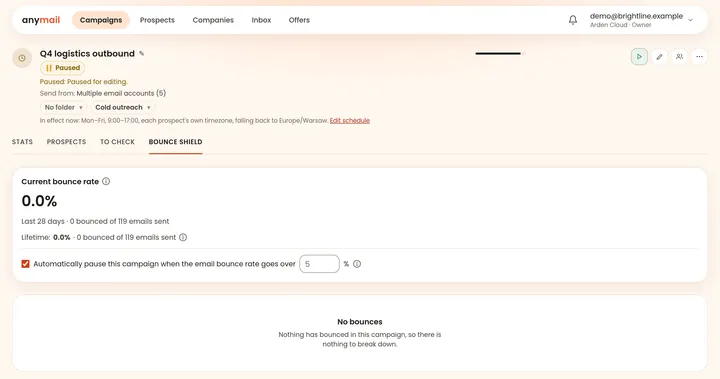
- Open the bounce shield tab and note which rule paused the campaign: the rate above your threshold, or three hard bounces in a row.
- Read the bounce messages. User unknown points to the list, mailbox full is often temporary, and blocks that mention policy or authentication point to your setup.
- Group the bounced addresses by source file and by recipient domain.
- Suppress every hard-bounced address, verify the unsent part of the list and keep catch-all addresses as a separate, riskier group.
- If a message mentions authentication, check SPF, DKIM and DMARC.
- Resume at about half the previous daily limit, watch the first few dozen sends, then raise the limit step by step.
Why it matters
A campaign often runs overnight, so a bad list can go out in full before anyone looks at a chart. A pause costs a few hours, while a burst of bounces can damage your domain's reputation. A pause on the rate points to a general list problem, and three in a row often points to one bad batch or source.
Watch out for
- Raise the threshold only when you know the cause and the cause is gone. It is there to protect the domain.
- The three-in-a-row rule has no threshold to change and no minimum of 20 sends.
- Receiving servers write the bounce messages, and some hide the real reason.
Good practice
- Keep bounced addresses on the suppression list, so the next import does not bring them back.
- Write down the cause before you press resume.
- If bounces rise again after the restart, stop and go back to the list source.
On day five, Jane's campaign pauses after three hard bounces in a row at one company that moved to a new domain. Her rate is 2.5%, 6 from 240 attempts, under her 3% threshold. She suppresses the old domain and resumes at 8 new people per mailbox per day instead of 15.
Go deeper: Your cold email campaign paused because of bounces. What now?